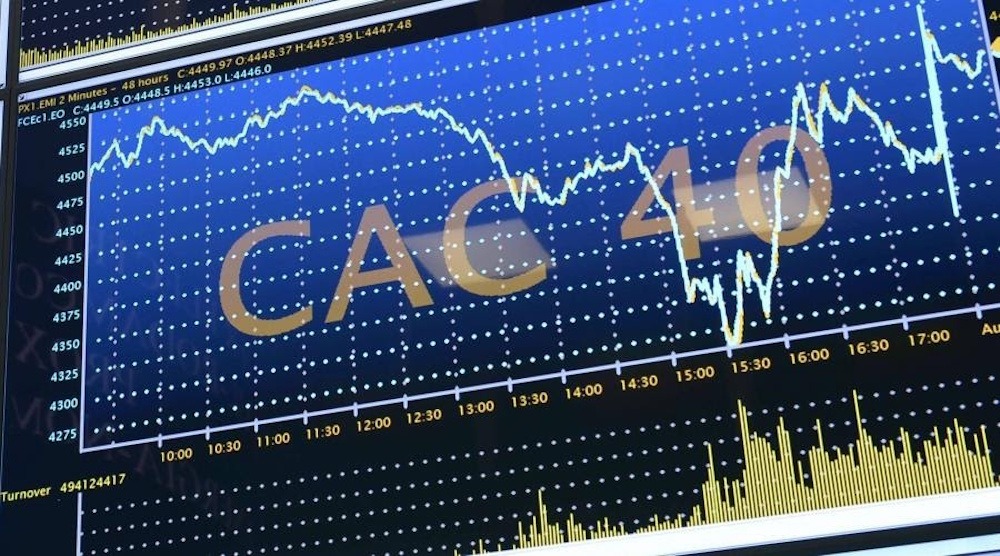
French stocks experienced a decline on Thursday, continuing their recent downward trend, influenced by rising oil prices and a stagnation in Middle East peace negotiations. Oil prices experienced an upward movement once more as investors assessed the likelihood of enhanced Saudi export flows in contrast to the risks of additional supply disruptions. Brent crude front month futures increased to $106.50 a barrel before declining to $105.10, maintaining an approximate 2% gain after a rise of around 4% that ended a five-day losing streak on Wednesday, driven by intensified uncertainty regarding U.S.-Iran negotiations.
Following U.S. President Trump’s threat to ‘annihilate’ Iran, Tehran responded by stating its readiness for dialogue, diplomacy, and negotiations, while rejecting the use of force in discussions. The benchmark CAC 40, which declined to 8,049.56 earlier, was down 27.98 points or 0.34% at 8,095.43 nearly half an hour past noon.
- STMicroelectronics experienced a decline of over 3%.
- Thales experienced a decline of 2.7%, while Societe Generale saw a decrease of 2.5%.
- Stellantis and Capgemini experienced declines of 2.1% and 2%, respectively.
- Renault experienced a decline of 1.7%, even as car sales in the Eurozone increased by approximately 4.5% in the previous month.
- EssilorLuxottica, Dassault Systemes, Airbus, Bureau Veritas, Credit Agricole, and Legrand experienced declines ranging from 1% to 1.6%.
- Carrefour, TotalEnergies, and Pernod Ricard experienced increases ranging from 1.1% to 1.4%.
- Meanwhile, AXA, L’Oreal, and Eurofins Scientific saw advancements between 0.6% and 0.9%.
In economic news, France’s manufacturing business climate index remained at 101 in September, consistent with the revised figure from August and the reading from July, albeit slightly below market expectations of 102. French consumer confidence persisted in its weakness, holding steady for the second consecutive month in September. The consumer sentiment index registered at 86.0 in September, unchanged from the preceding two months. Meanwhile, forecasts from economists anticipated a decline in the score to 85.0.
In September, France’s overall business climate indicator score decreased to 96, down from 98 in the preceding month, continuing its descent below the long-term average of 100. The euro area private sector experienced its most rapid expansion since April 2023, driven by robust growth in both the services and manufacturing sectors, as indicated by survey data from S&P Global released on Wednesday. The flash composite output index advanced to 53.1 in September from 52.0 in the prior month. The score registered at 51.7.